Quick Answer
Yes, buying pre-construction property in Panama is a legitimate and popular way to purchase real estate, but it comes with trade-offs. You typically lock in a price 15% to 30% below a finished unit and pay in staged installments over 24 to 36 months, in exchange for waiting, carrying construction risk, and accepting that your deposit is not automatically escrowed. It suits patient buyers and investors who do their due diligence; it is not a guaranteed profit.
Key Takeaways
- Pre-construction buyers in Panama usually sign a promise-to-purchase with a down payment of about 10%, then pay the balance in interest-free installments during construction.
- Off-plan prices typically run 15% to 30% below the price of a completed new build, and buyers in high-demand areas have seen values rise 20% to 40% between reservation and delivery.
- Buyer deposits are not legally required to be held in escrow in Panama; escrow is available only through licensed banks and trust companies (fiduciaries).
- Banks generally will not lend during construction, so most buyers take a local mortgage at completion, with foreign buyers typically putting down 30% to 50%.
- The biggest risks are construction delays, developer failure, and unfinished projects, so a developer's track record matters as much as the price.
- New homes may qualify for transfer-tax relief under Law 546 of 2026 and the $3,000 Abono Pa' Ti subsidy under Executive Decree 35 of 2026.
- Always use an independent Panama attorney to review the contract, the building permit, and the horizontal-property regime before you sign.
What Is Buying Pre-Construction Property in Panama, and Is It Right for You?
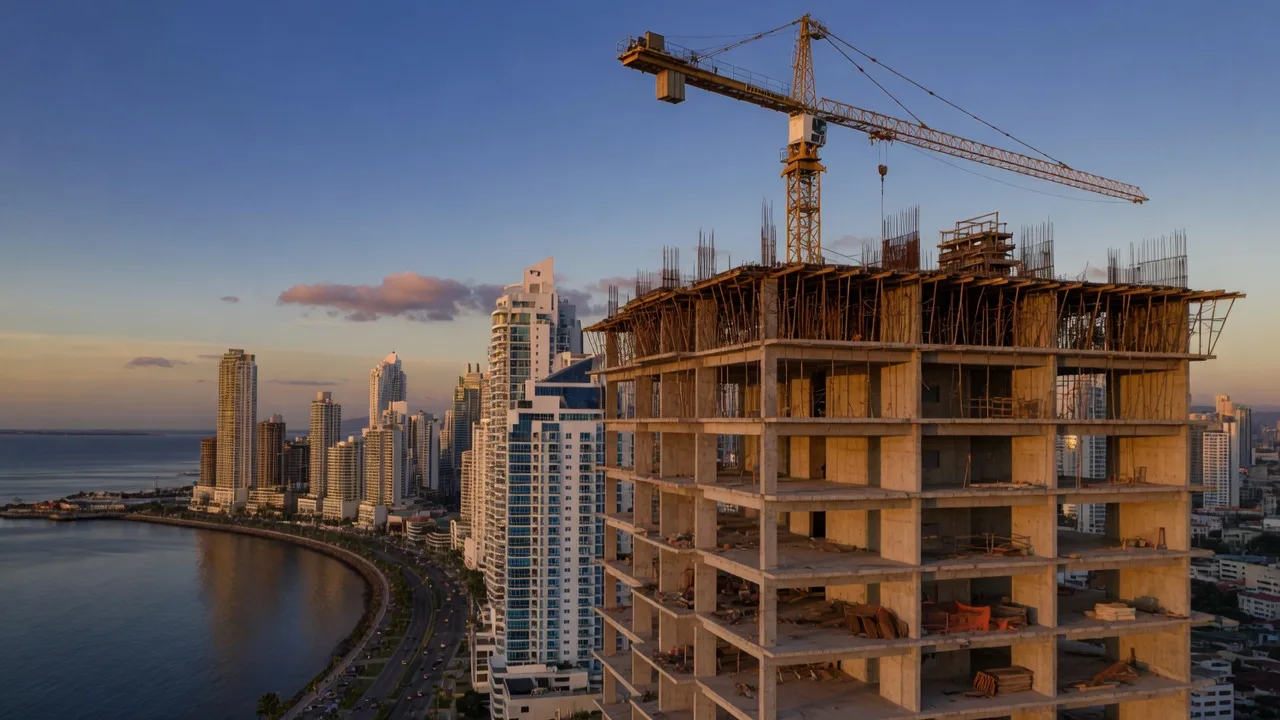
Buying pre-construction property in Panama means purchasing a unit in a building or development before it is built, based on the developer's plans and a promise-to-purchase agreement. It is one of the most common ways international investors enter the Panama market, especially in Panama City and along the Pacific beach corridor. The appeal is simple: you buy at today's price, pay over time, and hope the finished unit is worth more than you paid.
But it is not a risk-free shortcut. You are committing capital to a project that may be delayed, changed, or in the worst case never finished. This guide walks through how the payment plans work, what a fair price looks like, the real risks, and the steps to protect yourself. If you want the straight version, here it is: pre-construction can reward a patient, well-researched buyer, and punish a rushed one.
How Pre-Construction Payment Plans Actually Work
Unlike a resale, where you pay the full price at closing, a pre-construction purchase spreads your payments across the construction period. The standard structure starts with a reservation, then a promise-to-purchase agreement (promesa de compraventa), then a schedule of installments.
A typical plan looks like this: you pay about 10% down at signing, then spread the rest of your equity, often another 20% to 30% of the price, across interest-free monthly or milestone-based installments over the 24 to 36 months of construction. The balance is due as a balloon payment when the building receives its occupancy permit, which most buyers cover with a mortgage or by selling another asset. Some developers ask for more up front, sometimes 30% to 40% during construction.
| Payment Plan Element | Typical Arrangement | Notes |
|---|---|---|
| Reservation | $5,000 to $20,000 | Holds the unit; usually credited to the price |
| Down payment at signing | About 10% | Paid with the promise-to-purchase |
| Installments during construction | 20% to 30% of price | Interest-free, monthly or by milestone |
| Balance at completion | 60% to 70% | Balloon payment, often refinanced with a mortgage |
Read the schedule carefully before signing. Confirm whether installments are tied to construction milestones or fixed calendar dates, what happens if a milestone slips, and whether late payments carry penalties. The "interest-free" label is only true if the price does not already build in a financing charge, so compare the total you pay against the cash price.
Pre-Construction vs. Resale: The Real Price Difference
The price gap between pre-construction and resale in Panama runs in two directions depending on what you compare. Off-plan units are usually priced below a finished new build, but finished new construction sells at a premium over older resale units in the same area. Understanding this is what stops you from overpaying.
| Factor | Pre-Construction | Resale |
|---|---|---|
| Price level | Roughly 15% to 30% below a finished new build | Finished new builds run 15% to 35% above older resale |
| Payment timing | Staged over 24 to 36 months | Full price at closing |
| Wait to move in | 18 to 36 months | Immediate |
| Rental income | None during construction | Possible immediately |
| Risk | Delays, developer failure, spec changes | Condition and title issues |
| Customization | Sometimes floor-plan and finish choices | As-is |
As a rough guide, Global Property Guide's 2026 data shows pre-construction asking prices often sit well above nearby resale. On Avenida Balboa, resale units were around $2,400 per square meter while pre-construction asked about $3,300 per square meter, a premium of roughly 38%. In Casco Viejo the gap was smaller, with resale near $3,800 and pre-construction near $4,300 per square meter, about 13%. The lesson: a "pre-construction discount" is relative to a comparable new build, not necessarily to the older unit next door.
The Potential Upside: Discounts and Appreciation
Done well, pre-construction can be the most cost-effective way to buy. Because you commit early, developers often price units below what they expect to charge at delivery, and buyers in high-demand zones have historically seen values rise 20% to 40% between reservation and completion. Early buyers who resell at delivery can capture that appreciation while having paid only a fraction of the price.
That is the upside, and it is real, but it is not guaranteed. Appreciation depends on location, demand, the broader market, and the developer delivering on schedule and to spec. A unit in a sought-after Panama City district with strong rental demand is a different proposition from a speculative project in an area with little resale activity. Treat any projected gain as a possibility, not a promise.
The Risks You Cannot Ignore
Pre-construction carries risks that a resale does not, and it is important to name them plainly.
Construction Delays
Delays are the most common problem. Projects slip for many reasons, and a delay of months or even years is not unusual. Your contract should fix a maximum delivery date and spell out penalties for late delivery. Without clear terms, you have little leverage.
Developer Failure and Unfinished Projects
The most serious risk is a developer that runs into financial trouble and leaves a project unfinished. This is why the developer's track record matters so much. Check how many projects they have completed, whether those were delivered on time, and whether they are registered and in good standing.
Deposits Are Not Automatically Protected
Panama does not legally require pre-construction deposits to be held in escrow, and in practice many are paid directly to the developer. Escrow in Panama is regulated and can only be held by licensed banks and trust companies (fiduciaries). If you want protection, you can arrange for your payments to go through a licensed fiduciary, but you must confirm who actually controls the account.
Changes and Specs
Plans change. Confirm in writing that the contract fixes the unit's size, finishes, and specifications, and what happens if the developer substitutes materials or reduces quality. A vague contract is a promise you cannot enforce.
How to Protect Yourself: A Due Diligence Checklist
Most pre-construction problems are avoidable with the right checks before you sign. Here is what your due diligence should cover.
Verify the Developer
Ask for a list of completed projects and visit at least one. Speak to owners about whether delivery matched the promises. Confirm the developer is properly registered and has no history of abandoned projects.
Confirm the Permits and the Horizontal-Property Regime
Check that the project has a valid building permit and that the building will be registered under Panama's horizontal-property (condominium) regime, which is governed by Law 284 of 2022. This regime defines your unit, its common areas, and your ownership rights. A project that is not properly registered can cause serious problems at closing.
Use an Independent Attorney
Never rely on the developer's lawyer. Your own independent Panama attorney should review the promise-to-purchase agreement, the title, the building permit, and the horizontal-property registration, and should handle the closing.
Decide on Escrow
Because escrow is not automatic, decide explicitly how your money is protected. If a project is large and reputable, paying the developer directly may be acceptable, but for anything uncertain, route payments through a licensed fiduciary or bank escrow.
Read the Delay and Cancellation Clauses
Know exactly what happens if the project is delayed, and what happens if it is cancelled. Can you recover your payments? Under what conditions? Get these answers in writing.
Financing a Pre-Construction Purchase
Banks in Panama generally will not lend against a unit that does not exist yet, so you cannot finance the construction phase with a mortgage. Most buyers fund the installments from cash or other assets, then take a mortgage at completion to cover the balloon payment.
When you do finance at completion, foreign non-resident buyers face stricter terms than locals. Banks typically lend 60% to 70% of the value at most, meaning a down payment of 30% to 50%. Interest rates for foreigners commonly run 6.5% to 9.5% all-in, including the 1% FECI surcharge (Special Interest Compensation Fund) that applies to non-primary residences and foreign borrowers without permanent residency, plus the life insurance banks require, and terms usually span 10 to 20 years, with the loan repaid by age 75. The Superintendency of Banks reference rate was 6.50% through early 2026. For a fuller breakdown, see our guide to getting a mortgage in Panama as a foreigner.
New-Home Tax Relief: Law 546 and the $3,000 Subsidy
Because pre-construction units are new homes at first sale, some qualify for government incentives that resale properties do not. Under Law 546 of August 31, 2026, the 2% transfer tax (ITBI) is waived on the first sale of new homes valued up to $120,000, with reduced rates on a sliding scale up to roughly $200,000. Separately, Executive Decree 35 of 2026 created the Abono Pa' Ti program, a $3,000 subsidy toward the down payment on new homes priced up to $80,000.
These measures target the entry level of the market, so many international buyers shopping above $200,000 will not qualify. But if your purchase is in that range, the savings are meaningful. Confirm with your attorney whether the property qualifies and that the deed is signed within the required window. See our explainer on the $3,000 subsidy and new-home tax relief for the details.
Who Should (and Shouldn't) Buy Pre-Construction in Panama
Pre-construction suits buyers who are patient, comfortable with risk, and able to tie up capital for two to three years. It fits investors who want to lock in a price and capture appreciation, and buyers who want a new unit customized to their taste. It works well in established, high-demand markets like Panama City and the Pacific beach corridor.
It is a poor fit if you need to move in soon, if you cannot afford to lose or delay your deposit, or if you are risk-averse. If you want a place to live now, or you want the reassurance of a finished, inspected property, a resale is usually the safer choice. There is no shame in that; the right decision depends on your situation, not on what sounds exciting.
Step-by-Step: Buying Pre-Construction in Panama
Here is the practical sequence, from first viewing to taking the keys.
- Choose the location and project. Compare markets like Panama City, Coronado, and the beach corridor, and shortlist developers with a proven track record.
- Reserve the unit. Pay a reservation amount to hold the unit while you review the documents.
- Have your attorney review everything. The promise-to-purchase, the building permit, the horizontal-property regime, and the payment schedule.
- Sign the promise-to-purchase and pay the down payment. This is the legally binding step that fixes the price and terms.
- Pay installments on schedule. Keep records of every payment and confirm they are credited correctly.
- At completion, take out financing if needed. Arrange your mortgage and complete the final payment.
- Close and register the deed. Your attorney handles the notary and Public Registry registration, and you receive title.
Throughout, an independent attorney is not optional. They are the person who protects your interest in every step, and the cost is a small price for that protection. For the broader process, see our guide to the Panama buying process.
Frequently Asked Questions
Is buying pre-construction property in Panama safe?
It can be, but it carries more risk than a resale. The main risks are delays, developer failure, and changes to the finished unit. You reduce those risks by choosing an experienced developer, using an independent attorney, confirming the permits and horizontal-property regime, and deciding explicitly how your deposit is protected.
How much do I need for a down payment on pre-construction in Panama?
A typical plan asks for about 10% at signing, with another 20% to 30% paid in installments during construction. Some developers require more. If you finance the balance at completion, foreign buyers are generally expected to put down 30% to 50% of the value.
Can foreigners buy pre-construction property in Panama?
Yes. Foreigners can purchase pre-construction property in their own name with the same rights as Panamanian citizens, and no residency is required. The same rules and due diligence apply as for any buyer.
Are pre-construction deposits held in escrow in Panama?
Not automatically. Panama does not require pre-construction deposits to be escrowed, and many are paid directly to the developer. Escrow is available through licensed banks and trust companies (fiduciaries), so you can arrange it if you want that protection.
What happens if the developer delays the project?
It depends on your contract. A good contract fixes a maximum delivery date and penalties for delay, which may include compensation or the right to cancel and seek a refund. If the contract is silent, your options are weaker, which is why the terms matter before you sign.
Is pre-construction cheaper than buying a finished home in Panama?
Usually, but only compared with a comparable new build. Off-plan units are typically priced 15% to 30% below a finished unit, but finished new construction can sell for 15% to 35% above older resale units in the same area. Compare like for like.
Can I get a mortgage for a pre-construction purchase in Panama?
Not during construction, because banks will not lend against a unit that does not exist. You fund the installments yourself and typically take a mortgage at completion to cover the final balance. Foreign buyers generally qualify for 60% to 70% loan-to-value.
Thinking About Pre-Construction in Panama? Let Us Help You Decide
Pre-construction can be a smart move, but it deserves careful analysis before you commit. Please reach out to Panama Property Experts and we will give you the good, the bad, and the reality of any project you are considering, including our honest view of whether it is right for you. Call or WhatsApp us at +507-6356-7777 or email info@panamapropertyexperts.com to get started.
Sources and References
- The Panama Link, The Complete Panama Pre-Construction Investment Guide for Foreign Buyers 2026
- Prime Solutions Tax & Legal, Panama Escrow Guide for Safer Property Closings
- Global Property Guide, Panama Residential Property Market Analysis 2026
- Panama Equity, Why Pre-Construction in Panama Is Making a Comeback
- Icon Realty Group, Pre-Construction vs Resale Property in Panama
- Plan B Expat, Panama Mortgages for Foreigners 2026
- MIVIOT, Dirección de Propiedad Horizontal (Law 284 of 2022)
- Lawzana, What to Do About Construction Delays and Defects in Panama
Disclaimer: This article is for general information only and is not legal, tax, or financial advice. Laws, rates, and procedures can change. Confirm current figures and your specific situation with a qualified Panama attorney or accountant before proceeding.