Quick Answer
Yes. Foreigners can buy oceanfront property in Panama, but you never own the sand. The beach strip, roughly the first 22 meters from the high-tide line on the Pacific coast, is public state land. You buy registered, titled land just behind it with legal beach access. Titled finca property is safe to buy; possession-right (derecho posesorio) land is not. Verify the finca number before you commit.
Key Takeaways
- The beach strip, about 22 meters from the high-tide line on the Pacific coast, is public land in Panama and can never be privately titled.
- Buy only titled finca property with a Registro Público folio number; coastal possession rights (derechos posesorios) are not ownership and cannot be financed.
- Panama law requires a public beach-access servitude, so a coastal property must keep a clear, legal path to the beach.
- Panama sits south of the main hurricane belt; no hurricane has made direct landfall since 1969, though the Caribbean coast still gets heavy rain and swell.
- Budget 3% to 4% of the purchase price in buyer closing costs, plus the 2% transfer tax (normally the seller's) and annual property tax.
- Have a Panama attorney verify the maritime-terrestrial zone boundary and the finca title for your specific lot before you sign anything.
Can You Buy Oceanfront Property in Panama? Yes, With One Big Catch
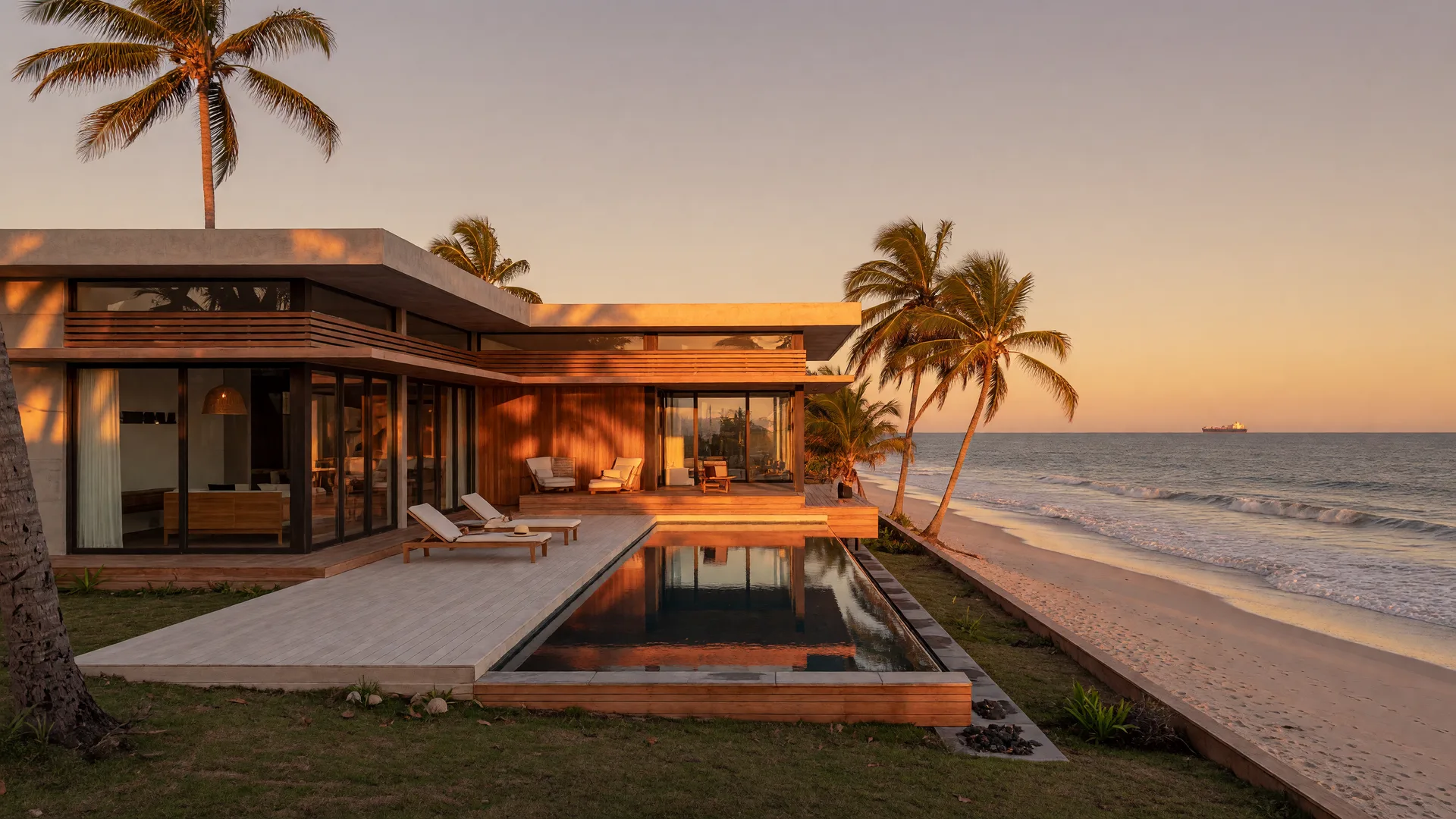
If you are researching buying oceanfront property in Panama, the single most important fact to learn first is what the beach actually is. Under Panamanian law, beaches and their shores are state property reserved for public use, so the sand you see in the listing photos is not something any private owner can hold title to. What a foreign buyer can own, with the same property rights as a Panamanian citizen, is registered titled land located just behind that public strip, with a legal way to reach the water. Understanding that line is the difference between a safe coastal purchase and a costly mistake.
Disclaimer: This article is general information, not legal advice. Laws and coastal boundaries can change, and every lot is different. Confirm every detail with a qualified Panama attorney before you sign anything or transfer money.
The good news is that foreigners have the same real-property rights as citizens. You do not need residency, a local partner, or special permission to buy. Thousands of international buyers have closed on beachfront homes in Coronado, San Carlos, and Playa Venao, and the process is well established. The risks are real, but they concentrate in two places: possession-right land sold as if it were titled, and coastal lots where the public beach strip, the title, or the access servitude was never verified. Both are avoidable with the right due diligence.
What "Oceanfront" Really Means in Panama: The 22-Meter Rule
Panama defines oceanfront differently from most countries, and the definition is set by the Constitution and by Ley 80 de 2009, which regulates coastal zones and the titling of lots along the coast and on islands. The law defines the ribera de playa, the beach shore, as the strip beginning at the high-tide line and extending inland. On the Pacific coast that public strip is set at 22 meters from the highest tide line; on the Atlantic coast the figure is commonly given as 10 meters. In both cases the land belongs to the State and is destined for public use.
Several practical rules follow from this. First, construction must be set back from the beach, so a "beachfront" home sits on titled land behind the public strip, not on the sand itself. Second, the law requires every coastal property to preserve a public beach-access servitude: a clear, permanent, legal path to the beach that the public can use. Transfers of property in coastal zones are not valid unless these access servitudes are in place. Third, the State also regulates a broader coastal band under the maritime-terrestrial zone regime, and the exact boundary for a specific lot must be confirmed with the relevant authority. A listing that promises "deeded access to the sand" is mischaracterizing what is legally possible.
Panama's highest courts have reinforced this repeatedly. In June 2021 the Supreme Court declared unconstitutional the legal article that had allowed the creation of artificial islands in the bay of Panama, on the grounds that the project violated the constitutional rule that beaches are public. If a developer or seller tells you that private beach ownership is available in Panama, that is a strong signal to walk away.
Titled Land vs. Right of Possession: The Coastal Trap
The single most common reason international buyers get hurt on oceanfront property is confusing titled land with right of possession (derecho posesorio, often called ROP). A titled finca is registered at the Public Registry with a permanent folio number that never changes. A possession right is a claim to occupy state land, often based on years of occupation, but the State still owns the land and there is no finca number. Coastal and island property, especially in places like Bocas del Toro and parts of the Azuero coast, is disproportionately sold as possession rights because much of it was never formally titled.
| Titled finca | Right of possession (ROP) | |
|---|---|---|
| What you own | Ownership, registered and enforceable against everyone | A right to occupy state land, not ownership |
| Registry record | Permanent finca / folio number at the Registro Público | No finca number |
| Financing | Panama banks lend against fincas | Cannot be mortgaged; cash only |
| Resale | Clean transfer by notarized, registered deed | Hard to resell; the buyer pool is tiny |
| Right for a foreign buyer | Yes, with proper due diligence | No, avoid entirely |
There are legal processes to convert possession rights into title through the National Land Administration (ANATI), but they are slow, discretionary, and not something a foreign buyer should plan a purchase around. If a seller offers you a beach lot and cannot give you a finca number, end the conversation. For a more detailed look at how possession-right scams work, see our guide on whether it is safe to buy property in Panama.
What Buying Oceanfront Property in Panama Costs
Oceanfront property in Panama spans a wide range. A titled beach lot in the Azuero or Chiriquí coastal areas might start around $150,000 to $250,000, while a finished beachfront home in a community like Buenaventura or Coronado typically runs $400,000 to over $1 million, and a prime Panama City bayfront condo can go well beyond that. Whatever the price, the cost structure on top of it is predictable, and it is the same for coastal and inland property.
| Item | Typical cost | Usually paid by |
|---|---|---|
| Transfer tax (ITBI) | 2% of the sale or registered value | Seller, but negotiable |
| Advance capital gains tax | 3% of value | Seller |
| Legal fees | 1% to 2% of the price | Buyer |
| Notary fees | About 0.1% (roughly $500 to $1,000) | Buyer |
| Public Registry registration | About $200 to $350 | Buyer |
| Title search and due diligence | $300 to $1,000 | Buyer |
Buyers should budget 3% to 4% of the purchase price for their own closing costs, on top of the deposit. The 2% transfer tax (ITBI) is normally the seller's to pay, but the split is negotiable, so confirm it in writing in the promise to purchase agreement. Our closing costs guide breaks this down in detail, and our property tax guide covers the annual side.
Annual property tax is modest and progressive. On a primary residence, the first $120,000 of value is exempt, the band from $120,001 to $700,000 is taxed at 0.5%, and value above $700,000 at 0.7%. Second homes and investments see a smaller exemption and slightly higher rates. Many beachfront communities also charge a monthly condo or HOA fee that covers security, landscaping, and common areas, so include that in your running costs.
The Buying Process for Coastal Property, Step by Step
Buying oceanfront property follows the same legal process as any other Panama purchase, with extra care on title and the coastal boundary. Here is how it works, in order.
- Get the finca number and the registered survey. Every genuine titled property has one. Ask for the folio real and the planimeter/survey, and compare the legal description with what you see on the ground. If the seller cannot produce a finca number, stop.
- Run the title search. Your attorney checks the full chain of title at the Registro Público, confirms every co-owner (all must sign the deed), and checks for mortgages, liens, embargoes, and pending litigation. Expect to pay $300 to $1,000.
- Verify the coastal rules for the specific lot. This is the step unique to oceanfront. Your attorney confirms the maritime-terrestrial zone boundary, the required beach setback, the beach-access servitude, and whether the land is titled freehold or held under a concession that limits what you can build.
- Review the environmental and municipal status. Coastal construction can require environmental permits and municipal clearances. Confirm that the existing structures were built with the required approvals, because an unpermitted house is a liability, not an asset.
- Sign the promise to purchase agreement. This contract sets the price, deposit, closing date, and who pays which costs. Escrow under Law 21 of 2017 keeps your deposit with a licensed trust company until the deed is registered.
- Close before a notary. The deed (escritura pública) is signed before a Panamanian notary. At this point the money moves through escrow and the transfer tax is filed.
- Register the deed. Ownership only transfers when the notarized deed is recorded at the Public Registry. Never accept "the deed is signed" as done; registration is the moment you actually own the property.
For a fuller walkthrough of each step, see our guide to the Panama buying process.
Where You Can Buy Oceanfront Property in Panama
Panama offers several very different oceanfront markets, and the right one depends on the lifestyle you want. A quick comparison:
| Market | Type of oceanfront | What to watch |
|---|---|---|
| Panama City (Punta Pacífica, Avenida Balboa, Costa del Este) | Bayfront condos and towers with ocean views | Mostly condominiums; the sand beach is small and city-side |
| Coronado and the Pacific corridor | Beach houses, condos, and gated communities | Titled beachfront exists, but confirm the strip and servitude lot by lot |
| San Carlos and Buenaventura | Beachfront homes and planned resort communities | Strong titled inventory; check the developer's track record |
| Playa Venao and Pedasí | Surf beaches, lots, and homes on the Azuero coast | Titled land available; infrastructure and access roads still maturing |
| Bocas del Toro | Caribbean islands and waterfront | Many possession-right listings; verify title with extra care |
Each of these is covered in more depth in our location guides for the Pacific beaches, Panama City, and Bocas del Toro and the Caribbean. If you are deciding between city and coast, our Panama City vs. Coronado comparison is a useful starting point. For buyers who prefer the highlands, note that Boquete and El Valle offer mountain and lake settings rather than oceanfront; that is a different lifestyle decision entirely.
Risks to Know Before You Buy on the Coast
Buying oceanfront property has real downsides, and the honest sellers, agents, and lawyers will tell you about them before you sign. Here are the ones that matter.
Erosion and climate. Coastlines move. The 22-meter public strip can shift as the shoreline changes, and a lot that feels safe today may not be there in a few decades. Check the erosion history of the specific beach, and understand that no title protects you from a coastline that is retreating.
Hurricanes and weather. Panama sits at about 7 to 9 degrees north latitude, south of the main Atlantic hurricane belt, and no hurricane has made direct landfall since 1969. But the Caribbean coast, especially Bocas del Toro, still gets the indirect effects of passing tropical systems: heavy rain, large waves, and prolonged wet weather. The Pacific coast is more sheltered. Flooding, not wind, is the bigger coastal concern, and the Caribbean coast receives roughly double the annual rainfall of the Pacific side.
Insurance. Panama has no state mandate for hurricane insurance, but a standard multi-risk homeowner policy can cover windstorm, hurricane, and flood, and lenders require structural coverage on financed properties. Coastal homes should carry it, and it costs more than inland coverage. Get a quote from a Panama broker before you commit to a specific property.
Beach access disputes. Because the law requires a public access servitude, neighbors and the community can legally use the path to the beach across privately titled land. If you were expecting a private, exclusive beach, adjust that expectation now. There is no such thing as a private beach in Panama, and courts have repeatedly struck down attempts to block public access.
Unpermitted construction. A house built without environmental or municipal approval is a serious liability. Verify permits before purchase, because you inherit the problem along with the property.
Possession-right land. We said it above and it bears repeating: the coastal market is where possession rights appear most often. If the deal is priced well below comparable titled property, ask why. Usually the answer is that it is not titled.
Is Oceanfront Property in Panama a Good Investment?
It can be, with the same honesty applied to every real estate investment. Oceanfront land in Panama is scarce and in steady demand from North American and European buyers, which supports values over time in established markets like Coronado and Panama City. Short-term rental income is realistic in places like Playa Venao, and our analysis of whether Airbnb is profitable in Panama walks through the actual numbers.
The counterweights matter too. Supply can outpace demand in newer beach developments, resale takes time, and an oceanfront property is costlier to insure and maintain than an inland one. Financing is also tighter: most foreign buyers pay cash or finance through a Panama bank against a titled finca, and possession-right land cannot be financed at all. Treat oceanfront as a lifestyle and long-term asset decision, not a get-rich-quick one. A well-titled property in a market with genuine demand and solid infrastructure has historically rewarded patient owners.
How to Start Your Oceanfront Search
If you are serious about buying oceanfront property in Panama, start the same way a careful local buyer would: decide on the region first, then verify title before you ever negotiate price. Choose the lifestyle you want (city bayfront, Pacific beach town, surf coast, or Caribbean island), compare the markets above, and shortlist properties that are titled fincas with the documentation ready to review.
At Panama Property Experts we work across Panama, not in a single development, so we can help you compare the Pacific beaches, Panama City, the Azuero coast, and the highlands against your actual lifestyle and budget. Our job is to protect your interests, and we will tell you when a property or an area is not right for you. We can also connect you with trusted independent attorneys, escrow, and survey professionals who handle the verification steps above.
Frequently Asked Questions
Can foreigners buy oceanfront property in Panama?
Yes. Foreigners have the same property rights as Panamanian citizens and need no residency or local partner to buy. The only geographic restriction is that land within 10 kilometers of the Costa Rican or Colombian border cannot be acquired by foreigners, which affects parts of Chiriquí, Bocas del Toro, and Darién, not the main Pacific beach markets.
How much does oceanfront property cost in Panama?
Prices vary widely by market. Titled beach lots in less developed coastal areas can start around $150,000 to $250,000, finished beachfront homes in communities like Coronado, San Carlos, or Buenaventura typically run $400,000 to over $1 million, and prime Panama City bayfront condos can go well beyond that. Your total cost includes roughly 3% to 4% in buyer closing costs.
Is beachfront property in Panama a good investment?
In established markets it has supported values over time, and short-term rental income is realistic in places like Playa Venao and Pedasí. But supply can outpace demand in newer developments, resale takes time, and coastal insurance and maintenance cost more than inland. Buy a well-titled property for the long term rather than expecting quick gains.
What is the 22-meter maritime-terrestrial zone?
It is the public beach strip that runs roughly 22 meters inland from the high-tide line on the Pacific coast (about 10 meters on the Atlantic). Under Panama's Constitution and Ley 80 de 2009 it belongs to the State and cannot be privately owned. You buy titled land behind this strip, never the sand itself.
What are closing costs when buying oceanfront property in Panama?
Budget 3% to 4% of the purchase price for buyer-side costs: legal fees of 1% to 2%, notary fees of about 0.1%, Public Registry registration of roughly $200 to $350, and a title search of $300 to $1,000. The 2% transfer tax is normally the seller's to pay, though the split is negotiable and should be confirmed in writing.
Is Panama safe from hurricanes for coastal property?
Panama lies south of the main hurricane belt, and no hurricane has made direct landfall since 1969. The Caribbean coast, including Bocas del Toro, still receives heavy rain and swell from passing tropical systems, while the Pacific coast is more sheltered. Flooding is the bigger concern, so coastal buyers should carry windstorm and flood coverage.
What is a derecho posesorio and why should I avoid it?
A derecho posesorio, or right of possession, is a claim to occupy state land rather than ownership of it. It has no finca number at the Public Registry, cannot be mortgaged, and is very hard to resell. Coastal property is often sold this way, and international buyers should avoid possession rights entirely and buy only titled fincas.
Let Us Walk the Coast With You
Whether you are comparing the Pacific beaches, Panama City, the Azuero coast, or the highlands, Panama Property Experts will give you the good, the bad, and the reality of oceanfront ownership. We know Panama, and our job is to protect your interests, not to rush you into a deal. Call or WhatsApp us at +507-6356-7777, or email info@panamapropertyexperts.com, and let us help you buy with confidence.
Sources and References
- Registro Público de Panamá (Public Registry), official
- Constitución Política de Panamá 1972 (rev. 2004), Articles 47 and 291 (Constitute Project)
- Ley 80 de 2009: Derechos posesorios y titulación de predios en zonas costeras (Justia Panamá)
- UNEP/FAO: Ley 80 de 2009, derechos posesorios y titulación en zonas costeras
- ARAP: Recursos Costeros, definición de ribera de playa
- Panamá América: Playas, riberas y fondos de mar son de uso público
- OBG Abogados: El acceso a las playas en Panamá, derecho de propiedad e interés público
- La Prensa: Corte declara inconstitucional artículo que permitió islas artificiales
- Lawzana: Titled Land vs. ROP Risks in Panama
- Janus & Hermes: Buying Property in Panama, the 22m beach strip and border zones
- The Latinvestor: Property Taxes, Fees and Costs in Panama
- ExpatDen: Home and Renters Insurance in Panama
Last reviewed October 2026. Figures and laws cited were verified against the sources above as of the publication date.